Wine Guide: Types, Grape Varieties and Regions Explained
Wine is simply fermented grape juice — yet it comes in thousands of styles shaped by grape, place, climate and winemaker. This guide gives you the map: the main styles, the grapes worth knowing and the regions behind them.
- Made from
- Fermented grapes
- Typical ABV
- 11–15% (fortified 15–22%)
- Main styles
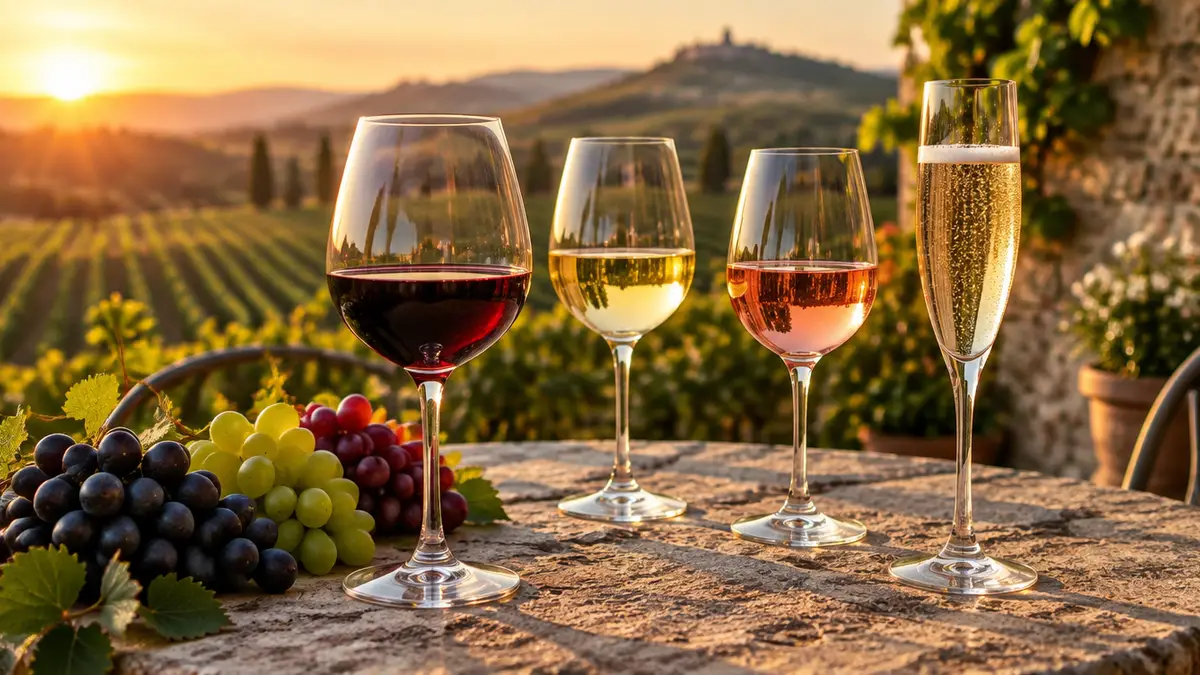
- Red, white, rosé, sparkling, fortified, sweet
- Standard pour
- 5 oz / 150 ml
- Serve
- 6–18 °C depending on style
A short history of wine
People have been making wine for at least 8,000 years. The earliest evidence comes from the South Caucasus — present-day Georgia — where grape residue was found in clay jars from around 6000 BC. Georgians still make wine in buried clay vessels called qvevri. Wine spread through the ancient Near East, Egypt, Greece and Rome, and the Romans planted vineyards across Europe, including many of today's famous regions in France, Spain and Germany.
In the Middle Ages, monasteries kept winemaking alive and mapped the best vineyard sites in Burgundy and elsewhere. From the 16th century European settlers planted vines in the Americas, South Africa and later Australia and New Zealand. Today wine is made in more than 70 countries.
How wine is made
- Harvest: grapes are picked when sugar, acidity and flavour are balanced.
- Crushing and pressing: for white wine, grapes are pressed and only the juice is fermented. For red wine, juice ferments together with the skins, which give colour and tannin.
- Fermentation: yeast turns grape sugar into alcohol over 1–4 weeks, in steel tanks, oak barrels or clay vessels.
- Ageing: from a few months in steel (fresh, fruity wines) to years in oak barrels (rich, complex wines).
- Bottling: wines may be blended, clarified and filtered, then bottled. Some keep improving in the bottle for decades.
The main styles of wine
Red wine
Made from dark-skinned grapes fermented with their skins. Reds range from light and juicy (Pinot Noir, Gamay) to powerful and tannic (Cabernet Sauvignon, Nebbiolo, Syrah). Typical flavours: red and black fruit, spice, earth, oak.
White wine
Usually made from green-skinned grapes, fermented without the skins. Styles range from crisp and zesty (Sauvignon Blanc, Albariño) to rich and creamy (oaked Chardonnay, Viognier) and aromatic (Riesling, Gewürztraminer).
Rosé
Made from red grapes with only brief skin contact — a few hours — which gives a pink colour. Most quality rosé is dry. Provence in France is the benchmark.
Orange (skin-contact) wine
White grapes fermented with their skins like a red, giving amber colour, tannin and flavours of dried apricot, tea and nuts. An ancient Georgian method that is popular again.
Sparkling wine
Bubbles come from a second fermentation that traps carbon dioxide.
| Wine | Country | Method | Style |
|---|---|---|---|
| Champagne | France (Champagne region only) | Traditional method (in bottle) | Fine bubbles, toast, citrus, brioche |
| Crémant | France (other regions) | Traditional method | Champagne-like, great value |
| Cava | Spain | Traditional method | Crisp, citrus, nutty |
| Prosecco | Italy | Tank (Charmat) method | Light, fruity, pear and apple |
| Franciacorta | Italy | Traditional method | Rich, creamy |
| Sekt | Germany / Austria | Tank or traditional | Fresh, often aromatic |
Fortified and sweet wines
Port (Portugal) is a sweet red wine fortified with grape spirit during fermentation. Sherry (Spain) ranges from bone-dry, salty Fino to rich, sweet Pedro Ximénez. Madeira is heated and oxidised on purpose and almost indestructible. Sweet wines like Sauternes, Tokaji Aszú and ice wine are made from grapes concentrated by noble rot, drying or frost.
Grape varieties worth knowing
| Grape | Colour | Tastes like | Famous regions |
|---|---|---|---|
| Cabernet Sauvignon | Red | Blackcurrant, cedar, firm tannin | Bordeaux (Left Bank), Napa Valley, Coonawarra |
| Merlot | Red | Plum, chocolate, soft | Bordeaux (Right Bank), Washington State |
| Pinot Noir | Red | Cherry, raspberry, earthy, silky | Burgundy, Oregon, New Zealand |
| Syrah / Shiraz | Red | Blackberry, pepper, smoke | Northern Rhône, Barossa Valley |
| Grenache / Garnacha | Red | Strawberry, spice, warm | Southern Rhône, Spain |
| Tempranillo | Red | Cherry, leather, vanilla | Rioja, Ribera del Duero |
| Sangiovese | Red | Sour cherry, tomato leaf, herbs | Chianti, Brunello di Montalcino |
| Nebbiolo | Red | Rose, tar, cherry, high tannin | Barolo, Barbaresco |
| Malbec | Red | Blackberry, violet, plush | Mendoza (Argentina), Cahors |
| Chardonnay | White | Apple, citrus; butter and vanilla if oaked | Burgundy, Chablis, California |
| Sauvignon Blanc | White | Grapefruit, gooseberry, cut grass | Loire (Sancerre), Marlborough |
| Riesling | White | Lime, peach, petrol, high acid | Mosel, Alsace, Clare Valley |
| Pinot Grigio / Gris | White | Pear, lemon, light | Northern Italy, Alsace, Oregon |
| Chenin Blanc | White | Quince, honey, apple | Loire (Vouvray), South Africa |
| Albariño | White | Peach, lime, sea breeze | Rías Baixas (Spain), Portugal (Alvarinho) |
Old World vs New World
Old World wines (Europe, plus Georgia and the Middle East) are traditionally named after their region and often taste more savoury, earthy and restrained. New World wines (Americas, Australia, New Zealand, South Africa) are usually named after the grape and tend to be riper and more fruit-forward. These are generalisations — cool-climate New World regions and modern European producers blur the line. Learn to decode both in our label guide.
How to drink wine
- Temperature: sparkling 6–8 °C; light whites and rosé 7–10 °C; fuller whites 10–13 °C; light reds 12–14 °C; full reds 16–18 °C.
- Glass: a tulip-shaped glass, filled to about a third. See the glassware guide.
- Decanting: helpful for young, tannic reds and older wines with sediment. See decanting tips.
- With food: wine was made to be enjoyed with meals. Try the Wine Pairing Tool.
What to try first
Light, fruity bubbles — easy and inexpensive.
Vibrant grapefruit and passion fruit; very recognisable.
Dry, delicate and endlessly food-friendly.
Soft, cherry-scented red with gentle tannins.
Juicy, plush and smooth — a crowd-pleasing red.
Low alcohol, a touch of sweetness, lots of flavour.
Taste slowly, alternate with water and eat something first. One standard drink of spirits is just 1.5 oz (44 ml) at 40% ABV. Never drink and drive. What counts as one drink?
Frequently asked questions
What is the difference between red and white wine?
Red wine is fermented with the grape skins, which add colour, tannin and flavour. White wine is usually fermented from juice only, without skins.
How many glasses are in a bottle of wine?
A standard 750 ml bottle holds five 5 oz (150 ml) glasses — each about one US standard drink at 12% ABV.
Does wine get better with age?
Only some wines. Most wines are made to be drunk within a few years. Wines with high tannin, acidity or sugar — such as top Bordeaux, Barolo, Riesling and vintage Port — can improve for decades.