What Is a Standard Drink? Alcohol Units and How Alcohol Affects the Body
A "drink" is not a glass — it is an amount of pure alcohol. Knowing what a standard drink looks like is the single most useful fact for anyone who drinks.
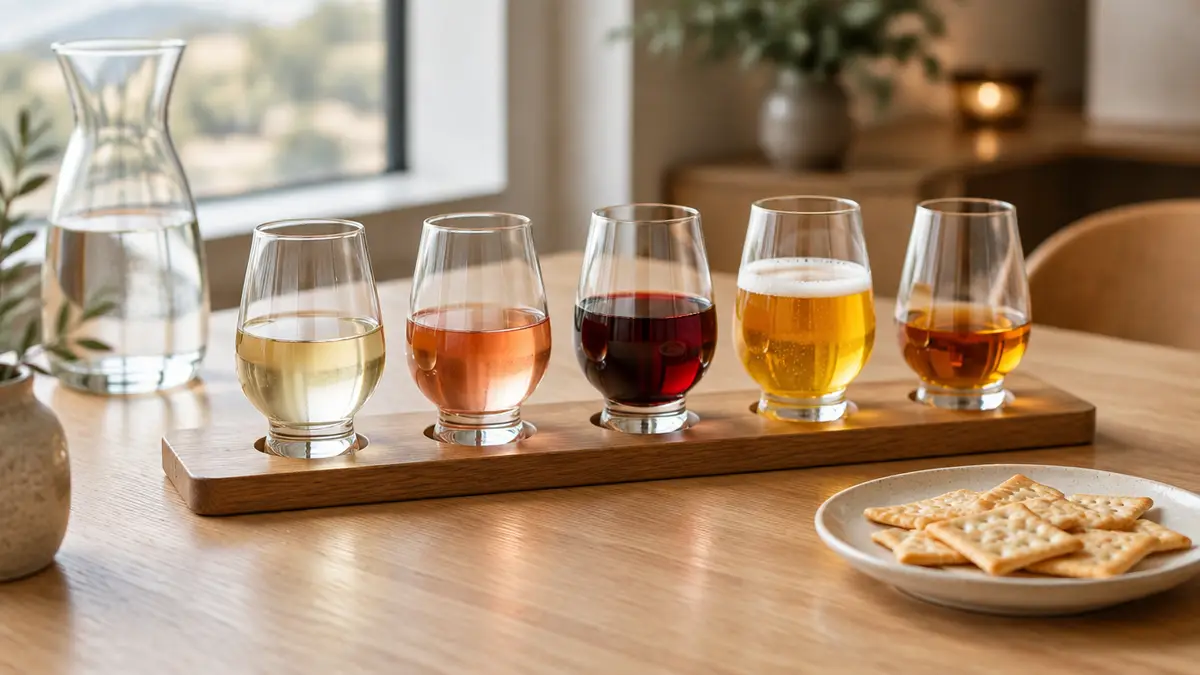
One standard drink, explained
In the USA, one standard drink contains about 14 grams (0.6 fl oz) of pure alcohol. That is roughly:
| Drink | Typical ABV | One standard drink |
|---|---|---|
| Regular beer | 5% | 12 fl oz (355 ml) — one can or bottle |
| Malt liquor / strong beer | 7% | 8–9 fl oz (240–265 ml) |
| Table wine | 12% | 5 fl oz (148 ml) — one-fifth of a bottle |
| Fortified wine (Port, sherry) | 17–20% | 3–4 fl oz (90–120 ml) |
| Liqueur | 24% | 2.5 fl oz (75 ml) |
| Spirits (vodka, whisky, gin, rum, tequila) | 40% | 1.5 fl oz (44 ml) — one shot |
- A 16 oz (473 ml) can of 8% IPA ≈ 2.7 standard drinks
- A large 9 oz (250 ml) glass of 14% wine ≈ 2 standard drinks
- A bottle of wine (750 ml, 13.5%) ≈ 5.7 standard drinks
- A Martini or Long Island Iced Tea ≈ 1.5–2.5 standard drinks
Standard drink calculator
Estimates only. The time to process alcohol varies widely with body size, sex, age, health, food and medication. You may still be impaired — and over the driving limit — the next morning.
Standard drinks in other countries
The size of a "standard drink" differs by country, which is why guidelines can look confusing:
| Country | One standard drink / unit |
|---|---|
| USA | 14 g of alcohol |
| Canada | 13.45 g |
| UK | 1 unit = 8 g (10 ml) of alcohol |
| Australia and New Zealand | 10 g |
| Many EU countries | Usually 10–12 g |
Drinking guidelines
Health authorities agree on one principle: less is better, and no amount of alcohol is completely risk-free. The World Health Organization states that there is no safe level of alcohol consumption for health. Common guidance includes:
- USA: long-standing federal guidance has advised adults who choose to drink to limit intake to 2 drinks or fewer in a day for men and 1 drink or fewer for women — and not to start drinking for health reasons.
- UK: the Chief Medical Officers advise not drinking more than 14 units a week on a regular basis, spread over three or more days, with several drink-free days.
- Canada: Canada's Guidance on Alcohol and Health (2023) describes 2 standard drinks or fewer per week as low risk, with risk increasing with each additional drink.
The U.S. National Institute on Alcohol Abuse and Alcoholism (NIAAA) defines binge drinking as a pattern that brings blood alcohol to 0.08% — typically about 4 or more drinks for women or 5 or more for men within about two hours. Binge drinking sharply increases the risk of injuries, violence, alcohol poisoning and risky decisions.
Who should not drink at all
- Anyone under the legal drinking age (21 in the USA).
- People who are pregnant or trying to become pregnant — no amount of alcohol is known to be safe during pregnancy.
- Anyone who will drive, operate machinery, swim, boat or do anything that requires alertness and coordination.
- People taking medicines that interact with alcohol — see alcohol and medications.
- People with certain medical conditions (such as liver disease, pancreatitis and some heart conditions).
- People recovering from alcohol use disorder, or who cannot control how much they drink.
How alcohol moves through your body
- Absorption: about 20% is absorbed through the stomach and most of the rest through the small intestine. Food in the stomach slows absorption; carbonation and drinking on an empty stomach speed it up.
- Circulation: alcohol travels in the blood to every organ, including the brain, within minutes.
- Metabolism: the liver breaks alcohol down into acetaldehyde (a toxic, cancer-causing chemical) and then into acetate. On average it clears roughly one standard drink per hour — but this varies.
- Only time sobers you up. Coffee, cold showers, fresh air, food or sleep do not speed up how fast your liver processes alcohol.
Blood alcohol concentration (BAC) and its effects
BAC is the percentage of alcohol in the blood. The same number of drinks produces a higher BAC in people who are smaller, female, older, drink faster or drink on an empty stomach.
| BAC | Typical effects |
|---|---|
| 0.02% | Relaxation, some loss of judgement, slight decline in visual function and ability to multitask |
| 0.05% | Exaggerated behaviour, lowered alertness, reduced coordination, impaired steering and response in emergencies |
| 0.08% | Poor muscle coordination, impaired judgement, self-control, reasoning and memory; legal driving limit in most US states |
| 0.10% | Clear deterioration of reaction time and control; slurred speech |
| 0.15% | Far less muscle control, major loss of balance, vomiting possible |
| 0.20–0.30% | Confusion, blackouts, danger of choking on vomit |
| 0.30% and above | Risk of loss of consciousness, alcohol poisoning and death |
Source: adapted from U.S. National Highway Traffic Safety Administration and CDC information.
Short-term effects
- Impaired judgement, coordination and reaction time — leading to injuries, falls, drownings and crashes.
- Lowered inhibitions and risky behaviour.
- Nausea, vomiting and dehydration; poor-quality sleep.
- Blackouts (memory gaps) at high doses.
- Hangovers: headache, fatigue, nausea, anxiety and low mood the next day.
- Alcohol poisoning, which can be fatal.
Long-term health risks
- Cancer: alcohol is classified by the International Agency for Research on Cancer as a Group 1 carcinogen. It increases the risk of at least seven cancers, including mouth, throat, oesophagus, liver, colorectal and breast cancer. Risk rises even at low levels.
- Liver disease: fatty liver, alcoholic hepatitis and cirrhosis.
- Heart and circulation: high blood pressure, irregular heartbeat (atrial fibrillation), cardiomyopathy and stroke.
- Brain and mental health: memory problems, depression, anxiety and dementia risk.
- Digestive system: pancreatitis, gastritis.
- Dependence: alcohol use disorder can develop gradually — see getting help.
Practical ways to drink less
- Count your drinks in standard drinks — use the calculator above.
- Alternate every alcoholic drink with water or a soft drink.
- Eat before and while drinking.
- Choose smaller servings and lower-ABV drinks, or try alcohol-free options.
- Set a limit before you start and plan alcohol-free days each week.
- Avoid rounds and drinking games that set the pace for you.
If you have questions about alcohol and your health, medications or a medical condition, talk to a doctor or pharmacist. In an emergency call 911 (USA), 999 (UK), 112 (EU) or your local emergency number.
Frequently asked questions
How many standard drinks are in a bottle of wine?
A 750 ml bottle of wine at 12% ABV contains about 5 US standard drinks. At 14% ABV it is nearly 6.
Does coffee sober you up?
No. Coffee may make you feel more alert, but it does not lower your blood alcohol or improve your judgement and reaction time. Only time allows the liver to process alcohol.
What is the difference between a unit and a standard drink?
They are different measures used in different countries. A UK unit is 8 grams of pure alcohol; a US standard drink is 14 grams. One US standard drink is about 1.75 UK units.