How to Read a Wine, Whisky, Cognac and Beer Label
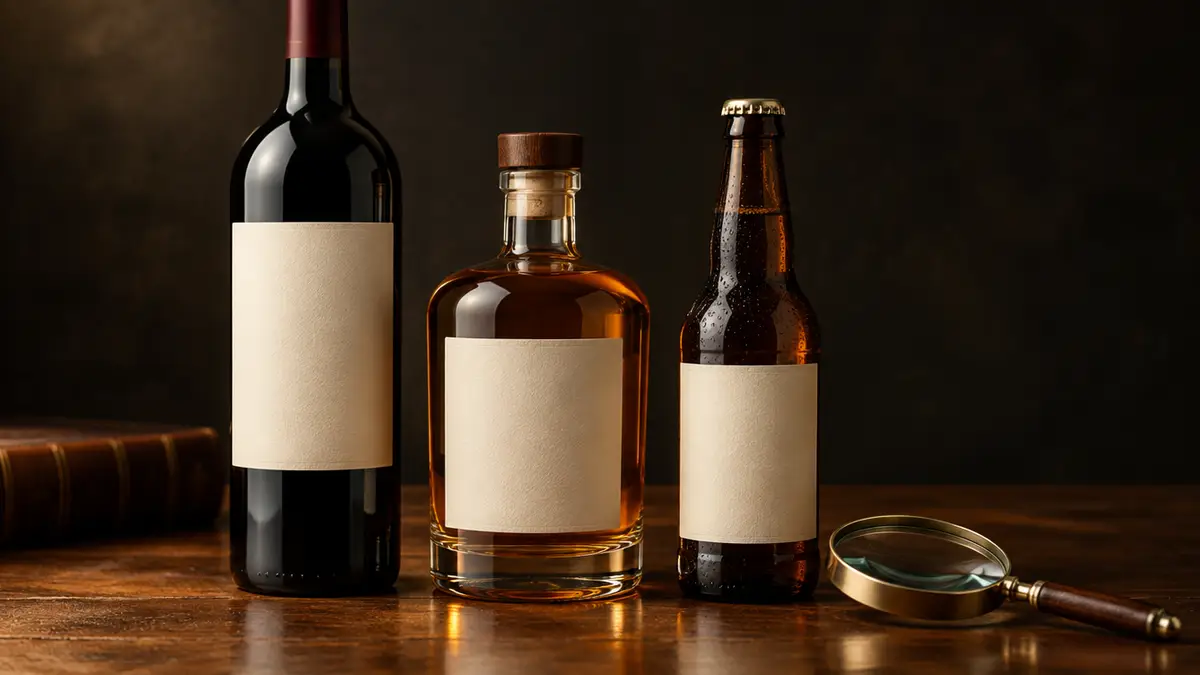
A label is a small instruction manual: it tells you what is inside, where it comes from, how old it is and how strong it is. Once you know what to look for, you can judge a bottle in seconds.
What every label must show
Rules differ by country, but most labels must include:
- Product name or brand, and the type of drink (e.g. "Kentucky Straight Bourbon Whiskey").
- Alcohol content as % ABV (and proof in the USA).
- Volume — 750 ml is the standard wine and spirits bottle; 700 ml is common in Europe for spirits.
- Producer, bottler or importer and country of origin.
- Allergens such as sulfites ("Contains sulfites") and, in the EU, milk or egg products used in fining.
- Health warnings — in the USA, the government warning about pregnancy and driving; similar pictograms in the EU.
Reading a wine label
Wine labels follow two main traditions:
| Old World (Europe) | New World (USA, Australia, Chile…) | |
|---|---|---|
| Main name | The place: Chablis, Rioja, Chianti Classico | The grape: Chardonnay, Malbec, Pinot Noir |
| Why | Rules define which grapes can be used in each region | Grapes are less restricted, so the variety is the key information |
| Example | "Bourgogne Rouge" = red Burgundy = Pinot Noir | "Sonoma Coast Pinot Noir" |
Key things to look for
- Region and classification: France: AOC/AOP, Premier Cru, Grand Cru; Italy: DOCG (highest), DOC, IGT; Spain: DOCa, DO, plus age terms Crianza, Reserva and Gran Reserva; Germany: Prädikat levels from Kabinett (lighter) to Trockenbeerenauslese (very sweet).
- Vintage: the harvest year. Most everyday wines are best within 1–4 years of vintage.
- Sweetness: terms like sec (dry), demi-sec (medium-sweet), trocken (dry), brut (dry sparkling).
- ABV: a quick style clue. 11–12.5% suggests a lighter, crisper wine; 14–15% a riper, fuller one.
- "Estate bottled" or "mis en bouteille au château/domaine": grown and bottled by the same producer.
- "Reserve": legally meaningful in Spain, Italy and Portugal (minimum ageing), but in the USA and Australia it is often just marketing.
Reading a whisky label
| Label term | What it means |
|---|---|
| Single malt Scotch whisky | 100% malted barley, one distillery, pot stills, at least 3 years in oak in Scotland |
| Blended Scotch whisky | A mix of malt and grain whiskies from multiple distilleries |
| 12 years old | The youngest whisky in the bottle is at least 12 years old |
| NAS (no age statement) | No age given — can be young or a mix of ages; quality varies |
| Cask finish (e.g. "sherry cask finish") | Aged in one cask type, then moved to another for extra flavour |
| Cask strength / barrel proof | Undiluted — often 50–65% ABV; add water to taste |
| Non-chill filtered | Not chilled and filtered before bottling; keeps more texture but may turn cloudy with ice |
| Natural colour | No caramel colouring (E150a) added |
| Straight bourbon | At least 2 years old, no added colour or flavour; if under 4 years the age must be stated |
| Bottled-in-Bond (USA) | One distillery, one season, at least 4 years old, bottled at exactly 100 proof |
Speyside tends toward fruity and honeyed, Highland toward rich and varied, Islay toward smoky and maritime, Lowland toward light and floral, Campbeltown toward briny and oily. These are tendencies, not rules.
Reading a cognac label
Cognac must come from the Cognac region of France and be double-distilled in copper pot stills from white wine. The key information is the age grade and the cru (growing area):
| Grade | Minimum age of youngest eau-de-vie | Style |
|---|---|---|
| VS (Very Special) / *** | 2 years | Fresh, fruity, ideal for cocktails |
| VSOP (Very Superior Old Pale) | 4 years | Rounder, more vanilla and spice |
| Napoléon | 6 years | Between VSOP and XO |
| XO (Extra Old) | 10 years | Rich, complex, dried fruit, leather, long finish |
| XXO / Hors d'Âge | 14 years / 10+ years | Very old blends |
Fine Champagne on a cognac label has nothing to do with sparkling wine: it means a blend of Grande Champagne and Petite Champagne crus, with at least 50% Grande Champagne — the most prized areas for long ageing.
Reading a beer label
- Style: the most useful word on the can — pilsner, hefeweizen, IPA, stout. See beer styles explained.
- ABV: ranges from under 0.5% (alcohol-free) to 12%+ for imperial stouts and barleywines. A 9% beer in a 16 oz can is almost three standard drinks.
- IBU: bitterness units, if shown. Under 20 is mild; 60+ is very bitter.
- Packaging or best-before date: hoppy beers like IPA are best within about three months; strong dark beers can age.
- Serving suggestions such as ideal glass or temperature.
Reading tequila and rum labels quickly
- Tequila: look for "100% de agave" (or "100% agave"). Without it, the tequila is a mixto. The NOM number identifies the distillery.
- Rum: terms like "gold", "dark" or "spiced" are not legally defined in most countries. Age statements on rum can be misleading (some are "solera" averages). Country of origin and distillation type tell you more.
Red flags on a label
- Spelling mistakes, blurry printing or a label that is crooked or peeling — possible counterfeit.
- Vague terms with no legal meaning: "premium", "reserve" (outside Europe), "smooth", "artisan".
- Very high ABV in a sweet, easy-drinking style (hard seltzers, alcopops or liqueurs) — easy to over-consume.
Frequently asked questions
What does the age on a whisky bottle mean?
It is the age of the youngest whisky in the bottle, counted only while in the cask. Whisky does not age further once bottled.
What is the difference between VS, VSOP and XO?
They are cognac age grades. The youngest brandy in the blend must be at least 2 years old for VS, 4 years for VSOP and 10 years for XO.
Why does my wine say "contains sulfites"?
Sulfites are a natural by-product of fermentation and are also added in small amounts as a preservative. Labelling is required because a small number of people, especially some with asthma, are sensitive to them.